
Ethics
Study SER-155-001 was a two-part first-in-human phase 1b clinical study performed in accordance with Good Clinical Practice Guidelines in adult participants undergoing allo-HCT (ClinicalTrials.gov identifier: NCT04995653). All participants provided written informed consent before undergoing any study-specific procedures, and the trial conformed to the Declaration of Helsinki. The protocol and all amendments were reviewed and approved by local and central institutional review boards for all participating investigative sites (Supplementary Table 5). An independent Data Safety and Monitoring Committee performed ongoing evaluations of safety and tolerability throughout the study. No patients or members of the public were involved in the design, conduct or reporting of this trial. The protocol and all amendments were reviewed and approved by local and central institutional review boards for all participating investigative sites (Supplementary Table 5).
Study design, oversight and participants
The study comprised two cohorts: open-label cohort 1 conducted at four US sites from November 2021 to February 2023 followed by a randomized placebo-controlled cohort 2 (1:1 randomization) conducted at 13 US sites, 11 of which enrolled participants, from September 2023 to July 2024. The trial was conducted in accordance with Good Clinical Practice (GCP). There were five protocol amendments to optimize study design. Notable changes for each amendment are listed below:
-
Amendment 1, dated 10 December 2021
-
specified the inclusion of at least one additional site in cohort 1 to allow greater flexibility with enrollment
-
added a halting rule in the case of two or more BSIs.
-
-
Amendment 2, dated 10 May 2022
-
Amendment 3, dated 30 September 2022
-
Inclusion criterion 3 was modified to allow participants who received HCT from an HLA 1-antigen mismatched unrelated donor (seven of eight allelic match at the HLA-A, HLA-B, HLA-C and HLA-DRB1 loci) to include a broader participant population without affecting study objectives.
-
GI infections were added as AESIs as they were of scientific and medical concern specific to the program and were reported and followed in the same manner as an SAE in the randomized-controlled cohort 2, a stratification factor of HCT conditioning regimen was removed as the HCT conditioning regimen may have changed after randomization.
-
-
Amendment 4, dated 24 May 2023
-
Cohort 2 study duration was shortened from 1 year to 6 months to allow a more focused capture of safety events associated with HCT and accompanying treatments; this 6-month study duration was expected to provide an initial understanding of the safety profile of SER-155.
-
Specified that HLA-matched and mismatched related donors were eligible as per inclusion criterion 3.
-
-
Amendment 5, dated 22 April 2024
-
Safety follow-up was truncated for a portion of cohort 2 participants who had not yet reached day 100 at time of reconsent; this 100-day window captured the period of highest risk for BSIs and aGvHD, as well as safety events related to HCT and accompanying treatments; additionally, by that time in the study, no safety halting rules had been met and no safety concerns were identified for SER-155.
-
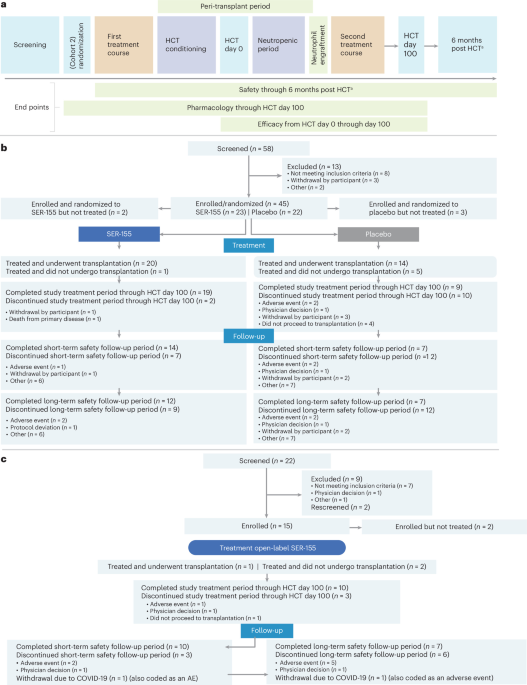
The trial consisted of a screening period of up to 2 weeks before enrollment/randomization, a treatment period of approximately 18 weeks through day 100 post-HCT and a safety follow-up period through 1 year post-HCT in cohort 1 and through 6 months post-HCT in cohort 2 (Fig. 1a). Cohort 1 enabled a stepwise safety evaluation while also investigating engraftment of SER-155 bacterial strains (PK), changes in GI microbiome composition and changes in host and microbial functional responses. Cohort 2 evaluated the safety, tolerability, PK, clinical efficacy and pharmacodynamics (PD) between participants treated with SER-155 versus placebo.
Inclusion criteria
To be eligible for enrollment, a participant was required to meet all the following inclusion criteria before randomization/enrollment:
-
(1)
Signed informed consent before initiation of any study-specific procedure or treatment. The participant was required to provide written informed consent and understand the potential risks and benefits from study enrollment and treatment.
-
(2)
Adult males and females aged ≥18 years scheduled to undergo allo-HCT.
-
(3)
Planned to undergo allogeneic hematopoietic stem cell transplantation with either bone marrow or peripheral blood stem cells as a graft source, and with any conditioning regimen: myeloablative conditioning, reduced intensity conditioning or non-myeloablative conditioning. The following donors were acceptable:
-
(a)
HLA-matched related donor (eight of eight allelic match at the HLA-A, HLA-B, HLA-C and HLA-DRB1 loci) or
-
(b)
Haploidentical related donor, or
-
(c)
HLA-matched unrelated donor, or
-
(d)
HLA 1-antigen mismatched unrelated or related donor (seven of eight allelic match at the HLA-A, HLA-B, HLA-C and HLA-DRB1 loci).
-
(a)
-
(4)
Able to swallow.
-
(5)
Participants were required to complete antibiotics for treatment of an active infection that was unrelated to the participant’s HCT standard of care before visit 2 (first dose of vancomycin (cohort 1) or vancomycin/placebo (cohort 2)).
-
(6)
Agreed to discontinue probiotics after study therapy initiation (starting with the first day of vancomycin for microbiome conditioning).
-
(7)
a) If female, was either:
-
i.
Not of childbearing potential, defined as postmenopausal (≥12 continuous months of amenorrhea with no other cause than menopause) or surgically sterile due to bilateral tubal ligation, bilateral oophorectomy or hysterectomy.
-
ii.
Of childbearing potential and participated in any activity associated with risk of pregnancy and is practicing at least one highly effective method of birth control (for example, intrauterine device, oral or parenteral contraceptives, a vasectomized partner, abstinence from sexual intercourse). The investigator discussed with the participant the option of practicing more than one of the above methods for the duration of the study.
b). If male and not surgically sterile, and the partner was of childbearing potential, the participant agreed to use a male condom with spermicide (double-barrier method) for the duration of the study. Abstinence of sexual intercourse was an acceptable method of birth control if it was used continuously for the duration of the study.
Exclusion criteria
A participant was not enrolled/randomized if the participant met any of the following criteria:
-
(1)
Had severe colitis of any etiology or active/currently treated inflammatory bowel disease or total colectomy.
-
(2)
Evidence of relapse or progression of hematologic malignancy (minimal residual disease was allowed) before visit 2 (first dose of vancomycin (cohort 1) or vancomycin/placebo (cohort 2)).
-
(3)
Female participants who were pregnant, breastfeeding, lactating or planned to become pregnant during the study.
-
(4)
Transplant using umbilical cord blood or ex vivo T cell-depleted HCT.
-
(5)
Concomitant participation, or participation within 14 days or five half-lives of other investigational unapproved treatments before visit 2, whichever was longer. Investigators discussed concomitant participation for approved or standard-of-care treatments with the medical monitor.
-
(6)
Receipt of chimeric antigen receptor T cell therapy.
-
(7)
Previously enrolled in a Seres Therapeutics SER-109, SER-262, SER-287 or SER-301 study.
-
(8)
Received a fecal microbiota transplant or any live microbial therapeutic within 3 months before screening.
-
(9)
Known hypersensitivity or allergy to at least two of the following antibiotics; ampicillin-sulbactam, tigecycline, metronidazole or imipenem. These antibiotics are effective against all SER-155 strains. By excluding participants unable to take at least two anti-infectives, there remained at least two other antibiotics to which SER-155 strains are susceptible in those who enrolled in the study.
-
(10)
Known allergy or intolerance to oral vancomycin.
-
(11)
Absolute neutrophil count (ANC) 3 at visit 2 (first dose of vancomycin (cohort 1) or vancomycin/placebo (cohort 2)).
-
(12)
Unable to comply with the protocol requirements, including the ability to take oral drugs; or any condition that, in the opinion of the investigator, might have interfered with study objectives or stool or blood sample collection, or compromised patient safety.
-
(13)
Previous receipt of an allogeneic transplant. Previous autologous transplant was permitted, unless it occurred within 90 days before screening.
-
(14)
Active, uncontrolled infection(s) requiring systemic therapy.
Concomitant medications
All GvHD prophylactic regimens, including PTCy were permitted. Lactulose use at any point during the study was discussed with the medical monitor due to its potential impact on GI conditions and thus SER-155 delivery.
Any other medications or treatments considered necessary for best patient care were permitted at the investigator’s discretion. In particular, the use of anti-infective regimens, chemotherapy, granulocyte colony-stimulating factors, immunosuppressive regimens and radiotherapy required for managing patients were as per the discretion of the transplant physicians.
Investigational product dosing regimen
Participants in both cohorts received two treatment courses, with each course consisting of 4 days of microbiome conditioning with oral vancomycin to facilitate SER-155 strain engraftment (125 mg, four times daily), or placebo in cohort 2, followed by 10 days of oral daily dosing of SER-155, or placebo in cohort 2. The first treatment course was administered before HCT conditioning (before allo-HCT) and the second course administered post-transplant after neutrophil engraftment, defined as an ANC > 500 cells per mm3 sustained for at least 3 consecutive days (Fig. 1a). A third course of SER-155 or placebo was administered without microbiome conditioning to participants who received three or more days of systemic antibiotic therapy.
The rationale for oral vancomycin administered before SER-155 was to condition the GI microbiome by transiently reducing the abundance of resident bacteria and thereby opening a niche for SER-155 strains to engraft.
Investigational product manufacturing, dose and formulation
The taxonomic assignments of the 16 bacterial strains in SER-155 are listed in Supplementary Table 6. SER-155 capsules were produced at Seres Therapeutics in accordance with Good Manufacturing Practices. Each strain in SER-155 was individually cultivated and then formulated in one of two separate formulations for administration:
-
SER-155 Part 1 contained a liquid formulation of bacterial spores from 11 strains delivered at a target dose strength of 6.9 × 10⁶ colony-forming units per dose (1 capsule)
-
SER-155 Part 2 contained a dry powder formulation of vegetative bacteria from five strains delivered at a target strength of 3.1 × 10⁷ colony-forming units per dose (one capsule).
Two capsules (one of each formulation) were administered as a single oral dose.
Commercially available vancomycin hydrochloride 125 mg capsules were over-encapsulated.
Participants randomized to the placebo arm in cohort 2 received inactive capsules for both vancomycin and SER-155 that were designed to be identical in appearance to active treatment.
Blinding and randomization (cohort 2 only)
Cohort 1 involves open-label (OL) treatment with SER-155. Cohort 2 included a randomization process to avoid bias in the assignment of participants to double-blind treatment (1:1 ratio of placebo or SER-155) and increase the likelihood that known and unknown participant characteristics will be evenly distributed between the treatment groups. At week −3, or as soon as the participant was deemed eligible, the participant in cohort 1 was assigned to the OL treatment regimen. In cohort 2, participants were randomized to placebo or SER-155 treatment regimen via the Interactive eXperience Response System (IXRS). Once a randomization number was assigned to a participant, the number was not re-used even if the participant discontinued from the study early or withdrew before receiving any oral vancomycin or SER-155 (study drug). Participants who discontinued from the study or who were previously randomized in the study were not permitted to re-enter.
In cohort 2, all sponsor staff and site personnel remained blinded to treatment assignments unless unblinding was required for safety reasons. Only limited study personnel had access to the treatment code. A designated randomization administrator from an external, independent vendor maintained the randomization codes for cohort 2 in accordance with standard operating procedures to ensure that the blind was properly maintained and that only personnel who required knowledge of treatment assignments were unblinded (for example, staff involved in SAE/AESI reporting).
Investigators were not to break the study treatment blind except when information concerning IP was necessary for the medical treatment of the participant. If a participant was unblinded, they would not receive any additional IP. No unblinding incidents (for safety reasons or otherwise) were reported on the study before final unblinding at database lock.
Study assessments and procedures
Clinical assessments and definitions
Participant race, ethnicity and sex data were based on self-report or health records. All TEAEs, SAEs and AESIs, predefined as any invasive infection, BSI or GI infection, were collected from initiation of the first treatment course through week 18. From week 18 through 1 year post-HCT (cohort 1) or through 6 months after HCT (cohort 2), only treatment-emergent SAEs and AESIs were collected. AE severity was assessed using the CTCAE, based on a five-point scale ranging from grade 1 (mild) to grade 5 (death). For each TEAE, the investigator made an assessment as to whether the event was causally related to IP. For cohort 2, each assessment was conducted in a blinded manner. Causality assessments for all adverse events, including those with fatal outcomes (deaths), were performed by the physician investigator reporting the AE, as per the causality assessment guidance as described in the study protocol (section 7.1.3.2), which follows all International Council for Harmonisation (ICH)-GCP and US FDA regulatory guidance. For the blinded, randomized, placebo-controlled cohort 2, causality assessment was performed in a blinded manner with respect to the investigational product (assessing both oral vancomycin and SER-155, independently).
BSI was defined as one or more positive blood cultures associated with systemic signs of infection such as fevers, chills and/or hypotension.
FN was defined as an ANC 3 with a single temperature reading of >38.3 °C (101 °F) or a sustained temperature of ≥38 °C (100.4 °F) for more than 1 h assessed from HCT day 0 through HCT day 100.
GvHD assessments were conducted per institutional guidelines by the site utilizing the Mount Sinai Acute GvHD International Consortium (MAGIC) criteria74 to stage and grade the severity of aGvHD.
Participants were monitored for GI infections, including C. difficile infection, viral infection or parasitic infection) of the GI tract manifesting as diarrhea or other GI signs and symptoms. These investigations differentiated infection from the same symptoms caused by aGvHD.
Pharmacology assessments
Stool samples for PK and whole-metagenomic sequencing (WMS), and blood samples for plasma biomarker analysis, were collected at predefined timepoints coinciding with planned study visits as shown in Supplementary Fig. 1. Stool samples were collected at eight timepoints: at screening or before treatment (baseline), after vancomycin/placebo dosing in each treatment course (post-microbiome conditioning), after SER-155/placebo dosing in each treatment course (post-treatment course 1 and post-treatment course 2), on the day of allo-HCT (HCT day 0), after neutrophil engraftment and before the second treatment course (post-neutrophil engraftment), and at HCT day 100 (HCT day 100). Samples following treatment course 1 were collected within 6 days before or 4 days after the start of HCT conditioning. Stool was shipped refrigerated to a central laboratory for aliquoting and storage.
Blood plasma samples for biomarker analysis were collected throughout the study at six timepoints: at baseline, post-treatment course 1, HCT day 0 and post-neutrophil engraftment, post-treatment course 2 and HCT day 100. Only plasma samples through the neutrophil engraftment timepoint were included in the analyses presented here. Plasma was shipped frozen to a central laboratory (Medpace Reference Laboratory (MRL)) for storage and testing.
Protocol deviations
Major protocol deviations were reported in 9 of 13 participants in the safety population in cohort 1 and 25 of 40 in the safety population in cohort 2 (Supplementary Table 1). No deviations were deemed to impact data integrity or interpretation. Two of 40 (5.0%) participants in cohort 2 (one participant in each treatment arm) entered the study but did not meet all inclusion criteria because a serum pregnancy test was not conducted. Other protocol deviations reported were those related to informed consent, primarily related to failure to initiate reconsent following a protocol amendment or consent by an unauthorized individual; IP violations due to missed doses or out-of-window dosing; GCP violations related to IP return/accountability or failure to report an SAE or AESI within 24 h of the investigator/site becoming aware; and receipt of an excluded concomitant medication; and end point-related procedural deviations related to missed stool sample collections and out-of-visit windows or delays.
Pharmacology analyses
SER-155 strain engraftment (PK)
SER-155 engraftment was evaluated in a presence/absence assay using a highly multiplexed, strain-specific molecular probe-based assay performed using the Nanostring nCounter platform, a digital molecular DNA barcoding technology. Each of the 16 SER-155 strains was targeted with 10–12 specific custom probes per strain, for 179 probes total. Probe uniqueness and specificity were achieved by using in silico healthy and diseased microbiomes to guide probe selection followed by extensive in-laboratory confirmation of specificity against related strains. An N – 3 threshold was selected to define strain detection, meaning a strain was deemed present if ≥N – 3 probes were detected above background, where N is the total number of probes for a given strain. It is expected that Nanostring probes will bind to some number of off-target closely related strains as unique genomic regions can be constrained, particularly for strains belonging to highly prevalent species.
Specificity, sensitivity and limit of detection (LoD) were evaluated for the Nanostring assay using three unique stools samples, each collected from a different healthy individual. Probe specificity was assessed for all 16 strains in each of the three stool samples. Only one of the 16 strains (S155-01) was detected, resulting in an overall specificity for the assay of 95.8% (46 of 48). Sensitivity and LoD were determined by serially diluting a mixture of SER-155 strains, spiking the cell mix into stool, and then performing the assay to detect each strain. At the highest spike level tested (4.17 × 10⁷ cells per g stool), all 16 strains were consistently detected, yielding an overall sensitivity of 100%. LoD was defined as the lowest concentration at which a strain was reliably detected across stools from three healthy individuals. For most strains (15 of 16), the LoD was 4.17 × 10⁶ cells per g stool, whereas one strain (S155-06) required a higher concentration (4.17 × 10⁷ cells per g stool) for consistent detection.
DNA was extracted from 10% ethanol stool suspensions (w/v) using a modified version of the Mag-Bind Universal Pathogen DNA kit (Omega, cat. no. M4029). DNA was then digested with Alu1 (NEB cat. no. R0137L) for overnight hybridization (≈24 h at 68 °C) with Nanostring’s Element 196 Tagset and probe pools generated at Integrated DNA Technologies. Following hybridization, samples were snap–cooled on ice, bound to a flow cell using our automated Nanostring Prep Station, and subsequently scanned on the Nanostring Digital Analyzer (field of view > 555). The assay readout was binary (presence/absence) outputs for both probe and strain-level detection. Rigorous quality control was required for data release and use, including assessing binding density, field of view, summed probe counts and process controls before data release. Samples failing prespecified criteria were retested in accordance with the protocol or excluded.
WMS sequencing and taxonomic classification
We characterized participant GI microbiomes using WMS performed on 10% ethanol stool suspensions. DNA was extracted as described above for the engraftment assay. DNA was quantified (Quant-IT Picogreen dsDNA Assay kit, Thermo Fisher; cat. no. P7589) and the positive and negative extraction controls were confirmed before library preparation. Extracted DNA underwent simultaneous fragmentation and Illumina sequencing primer addition via bead-linked transposomes (DNA Prep kit, Illumina, cat. no. 20060059). Libraries then received low-cycle PCR amplification, underwent bead-based cleanup, followed by pooling before sequencing on an Illumina Novaseq 6000 (2 × 151 bp) to a target depth of 10 gigabases. Sequencing was performed by Broad Clinical Laboratories. Before WMS data release and analyses, all process controls were evaluated to ensure that they met predefined acceptability criteria.
Species-level taxonomic identities were assigned by mapping reads against a custom Seres marker database of bacterial and archaeal species. Raw WMS reads underwent pre-processing to remove internal spike controls, human sequences, technical artifacts and low-quality bases before mapping75. Because the LoD for a given species depends on the sequencing depth, WMS reads for each sample were downsampled to 6,000,000 reads to ensure samples were compared at equal sequencing depth. A Seres custom implementation of the MetaPhlAn algorithm76, a taxonomic profiling tool, was used to map reads to the custom marker database to identify species and estimate relative abundance based on the distribution of mapped reads77. The custom marker database incorporates a hierarchical taxonomy (species to phylum), enabling analysis of higher-order taxonomic groups (for example, family) by summing constituent species abundances.
Pathogen domination prevalence
Seres evaluated families of bacterial taxa consisting of potential opportunistic pathogens that have been demonstrated to be prevalent and abundant in the GI tract during HCT: Enterobacteriaceae, Enterococcaceae, Streptococcaceae and Staphylococcaceae. For each of these families, the relative abundance of all member species was summed to derive a family-level relative abundance measure. The prevalence of domination for each family (and the prevalence of domination of any of these four families) was evaluated at each individual visit in the transplant period by calculating the prevalence of domination among participants with available samples. A 30% relative abundance threshold was used to classify domination events.
Fecal albumin
Fecal albumin was quantified via ELISA (ImmunDiagnostik, cat. no. KR6630) at Cerba Health Care (Belgium) using a validated assay. The lower limit of quantification was established to be 3,125 ng ml−1 and was used for imputation. Fecal albumin was quantified from a cohort of 25 healthy individuals (described below) to establish a method-specific reference range during validation.
Blood plasma biomarkers
Blood samples were collected (K2EDTA tubes), centrifuged at the study site, and the separated plasma was immediately aliquoted into eight cryovials, frozen and shipped to MRL for analysis. Plasma protein biomarker concentrations were determined using automated or manual ELISA assays except for high sensitivity C-reactive protein (hsCRP), which was quantified via Automated Nephelometric Immuno-Assay. To minimize batch variation effects, we made best efforts to concurrently test all plasma samples from each patient up to and including HCT day 100, except for hsCRP, which was analyzed immediately upon sample arrival. All assays were validated at MRL. Imputation and stability criteria varied by biomarker. Values below the lower limit of quantitation or above the upper limit of quantitation, established during assay validation, were imputed.
End points
The primary end point was safety and tolerability of SER-155 evaluated through 1 year post-HCT in cohort 1 and through 6 months in cohort 2. Safety, including mortality events, was evaluated as described in the clinical protocol and in accordance with US FDA and ICH guidelines. The primary PK end point was the prevalence of SER-155 strains in participant stool (engraftment) before the first treatment course through day 100 post-HCT.
Secondary efficacy end points were evaluated from HCT day 0 (day of transplant) through HCT day 100) and included incidence of BSI, incidence and duration of FN, incidence of aGvHD ≥ grade 2 (MAGIC criteria), and incidence of GI infection. Secondary PD end points included abundance of Enterococcus spp. and Enterobacteriaceae spp. in stool, via genomic assessment, before the first treatment course through HCT day 100.
Exploratory efficacy end points included utilization of system antibacterial and antimycotic agents for treatment of an AE from HCT day 0 through HCT day 100. Exploratory PD end points included GI microbiome change, GI domination by pathobionts before and after IP administration through day 100 post-HCT and change in plasma biomarkers, including proinflammatory cytokines.
Determination of sample size
The planned sample size of up to 15 participants in cohort 1 was to provide initial safety and tolerability information. The planned sample size of approximately 60 participants randomized in a 1:1 ratio was designed to capture frequent AEs (defined as an incidence rate of 10% or above) with high probability. A sample size of 28 had a 95% probability of detecting a frequent AE, and a sample size of 22 had 90% probability of detecting a frequent AE. Considering potential dropout rate, a planned sample size of 30 was used for the SER-155 arm in this study. A sample size of 15 participants were enrolled in cohort 1. A sample size of 45 participants was enrolled in cohort 2, which was deemed sufficient to inform key end points per protocol and SAP. The decision to modify the study design and reduce cohort 2 enrollment from 60 to 45 participants was reviewed and approved by the Data Safety Monitoring Committee who regularly reviewed trial safety data and final sample size was communicated to the US FDA and included in the final clinical study report. This change is further noted in the statistical analysis plan, where it is stated that “A sample size of approximately 50 participants were enrolled in cohort 2, which was deemed sufficient to inform the primary, secondary and exploratory end points per protocol and statistical analysis plan.”
Statistical analyses for clinical end points
All safety and tolerability data were presented descriptively using the safety population for both cohorts, which includes all participants who received any amount of IP. Clinical efficacy end points were analyzed using cohort 2 only for the mITT-1 population, referred to in text as the efficacy population, which included all participants who received any amount of IP and received transplant. Continuous data were summarized by treatment arm using descriptive statistics (number, mean, s.d., minimum, median and maximum). Categorical data were summarized by cohort and study arm using frequency tables (number and percentage). Exploratory hypothesis testing was conducted at the two-sided α = 0.05 level where specified. The 95% two-sided CIs and odds ratios for incidence were determined using the Clopper–Pearson exact method based on Fisher’s exact test, where specified.
The Kaplan–Meier method was used to summarize time to first BSI, beginning on or after HCT day 0. Participants who withdrew from the study early or who did not experience an event through HCT day 100 had their time on study censored after the last available corresponding assessment. Median time and first and third quartiles were presented with their 95% CIs. Greenwood’s formula was used for the s.e. of the Kaplan–Meier estimate in the calculation of these confidence limits. The stratified log-rank test was applied for comparing Kaplan–Meier curves for SER-155 versus placebo.
To account for potential confounding of differences in PTCy use between arms, a post hoc logistic regression analysis, adjusting for PTCy status, was conducted for incidence of BSI.
Data from participants who withdrew prematurely from the study were included in all analyses if available. Except for screen failure, participant data before the day of missing visit was retained unless consent was withdrawn.
As all hypothesis testing was exploratory, the study was not powered for efficacy end points, only nominal P values were provided to aid interpretation, and as such there were no adjustments for multiple comparisons or multiplicity.
No sex-based analyses were prespecified, and none were conducted.
SAS, v.9.4 (SAS Institute), was used for all analyses.
Statistical analyses of pharmacology end points
PK analyses were performed using the safety-PK population, defined as all participants in the safety population who received any amount of SER‑155/placebo.
PD end points were analyzed using cohort 2, mITT-1 population, unless noted otherwise. If a participant had no evaluable samples, that participant was dropped from the analysis population. If a participant was missing all samples within a particular analysis period, or missing a single sample at a particular visit, that participant was excluded from that analysis period or visit assessment, respectively. Samples were excluded due to quality issues in collection or handling (for example, leaked samples, samples with temperature excursions) or due to quality issues in data generated from samples.
All pharmacology statistical assessments were performed using R v.3.6.3. All data visualizations were performed with ggplot2 (v.3.5.0) unless otherwise specified. Exploratory hypothesis testing was conducted at the two-sided α = 0.05 level where specified. There were no adjustments for multiple comparisons or multiplicity.
Pharmacokinetics and SER-155 species relative abundance
A Wilcoxon rank-sum test was performed to evaluate the effect of treatment arm on the number of SER-155 strains detected in each participant and the summed relative abundance of SER-155 species in each participant at each individual visit. Prevalence of each individual strain across participants was calculated at each timepoint; no per-strain statistical assessments were performed comparing the SER-155 and placebo treatment arms.
Taxonomic composition
PCoA was conducted using the Bray–Curtis dissimilarity metric on species-level relative abundances using the cmdscale function, which computes classical multidimensional scaling from the dissimilarity matrix. All samples from the SER-155 and placebo arms and the healthy cohort were clustered together in a single PCoA, with visualizations faceted by arm/cohort. The first two principal coordinates were used to visualize sample clustering and assess group-level differences. PCoA ordinations and statistical assessments were performed on the safety population. To assess differences in community composition in SER-155 and placebo treatment arms and in a healthy comparator cohort (described below), we performed a PERMANOVA using the Bray–Curtis distance matrix and the adonis function (distance ≈ arm) in the vegan package (v.2.6-4) across all individual visits using a seed of 123. A total of 999 permutations were performed to assess statistical significance. Additional tests were performed using the vegan package to assess whether group dispersions (calculated with the betadisper) were significantly different between comparisons using a permutation test (permutest) using 99 permutations. Significantly different dispersions between groups indicate that a significant difference in the PERMANOVA statistic could be driven by differences in dispersion (average distance to group centroids) rather than differences in group centroids (multivariate means).
Shannon alpha diversity
Species relative abundance profiles were analyzed using the Shannon alpha diversity index78 calculated in R as \({H}^{{\prime} }=-\sum {p}_{i}\mathrm{ln}({p}_{i})\), where \({p}_{i}\) is the relative abundance of species i. Calculations were performed in R, after normalizing relative abundance to proportions. A Wilcoxon rank-sum test was performed to evaluate the effect of treatment arm on Shannon alpha diversity in each participant at each individual visit and in comparison to the healthy comparator cohort.
Pathogen domination prevalence
The impact of treatment arm on the prevalence of pathogen domination was assessed using a Fisher’s exact test through the peri-transplant window. A 2 × 2 contingency table was created that corresponded to the number of participants with and without domination in SER-155 treatment versus placebo for each scheduled visit and Fisher’s exact test was performed. The same method was used to evaluate whether domination prevalence of either arm differs from a historical comparator cohort of allo-HCT recipients, described below.
GI epithelial barrier integrity (fecal albumin biomarker)
Effects of SER-155 treatment on log10-transformed fecal albumin concentrations (mg ml−1) were assessed using a linear model (concentration ≈ arm) with a P value reported from the Wald test on individual visits through the peri-transplant period. The same model was used to assess differences between treatment arms and a healthy comparator cohort (n = 25, described below). The association between binarized post-transplant BSI occurrence and fecal albumin concentrations was evaluated using the same approach (concentration ≈ BSI). The interaction between treatment arm and the binarized timing of sample collection relative to the start of HCT conditioning (sample collection before versus on the day of or after HCT conditioning start) at the treatment course 1 visit was assessed to evaluate the impact of HCT conditioning on fecal albumin concentrations (concentration ≈ arm × timing relative to HCT start), with a P value reported from the Wald test on the interaction term (arm × timing).
Plasma biomarkers
The impact of SER-155 treatment on log10-transformed plasma biomarker concentrations was also assessed using the same linear model approach (biomarker ≈ arm) on individual visits through the peri-transplant period with P value reporting using the Wald test. Effect sizes were visualized using the heatmap package (v.1.0.12). Plasma biomarkers were assessed in the mITT-1 population in cohort 2 alone and in a combined analysis of cohort 1 and cohort 2.
Comparator cohorts
Healthy cohort used in beta diversity analysis
A WMS comparator cohort was compiled from samples from the Seres biorepository from 54 self-described, healthy individuals who provided written informed consent for biospecimen collection. Individuals with body mass index (BMI) > 30 kg m−2 and former and current smokers were excluded. Mean age was 38 years; 23 of 54 (43%) were female and mean BMI was 25 kg m−2. Stool samples obtained from this healthy cohort were processed with the same WMS methods described above and used in PCoA of Bray–Curtis beta diversity.
Healthy cohort used in fecal albumin analysis
Stool samples from 25 self-described healthy individuals were obtained by Cerba Health Care for use in fecal albumin assay validation. This cohort was used to contextualize fecal albumin concentrations at baseline through the peri-transplant period.
Historical comparator cohort of allo-HCT recipients used in pathogen domination analysis
A historical comparator cohort was compiled from a larger MSKCC cohort of patients receiving allo-HCT described in Peled et al.29 by selecting patients with available stool samples proximal to three key pre- and post-HCT events sampled in the current study (following treatment course 1, before/start of HCT conditioning (HCT day −14 to HCT day −1); HCT day 0, approximate day of transplant (HCT day 0 to HCT day 6); post-neutrophil engraftment, at the time of or following ANC counts >500 cells per mm3 for 3 consecutive days (0 to 7 days from neutrophil engraftment)). The selected comparator cohort consisted of 115 patients and a total of 323 stool samples. These patients received allo-HCT at MSKCC between 2016 and 2021 (patient demographics are presented in Supplementary Table 7). WMS data were produced for the historical cohort stool samples using the same methods described above. This historical cohort is a subset of a larger cohort presented in Peled et al.29; pathogen domination results reported from the subset recapitulate previous findings of the larger cohort.
Reporting summary
Further information on research design is available in the Nature Portfolio Reporting Summary linked to this article.